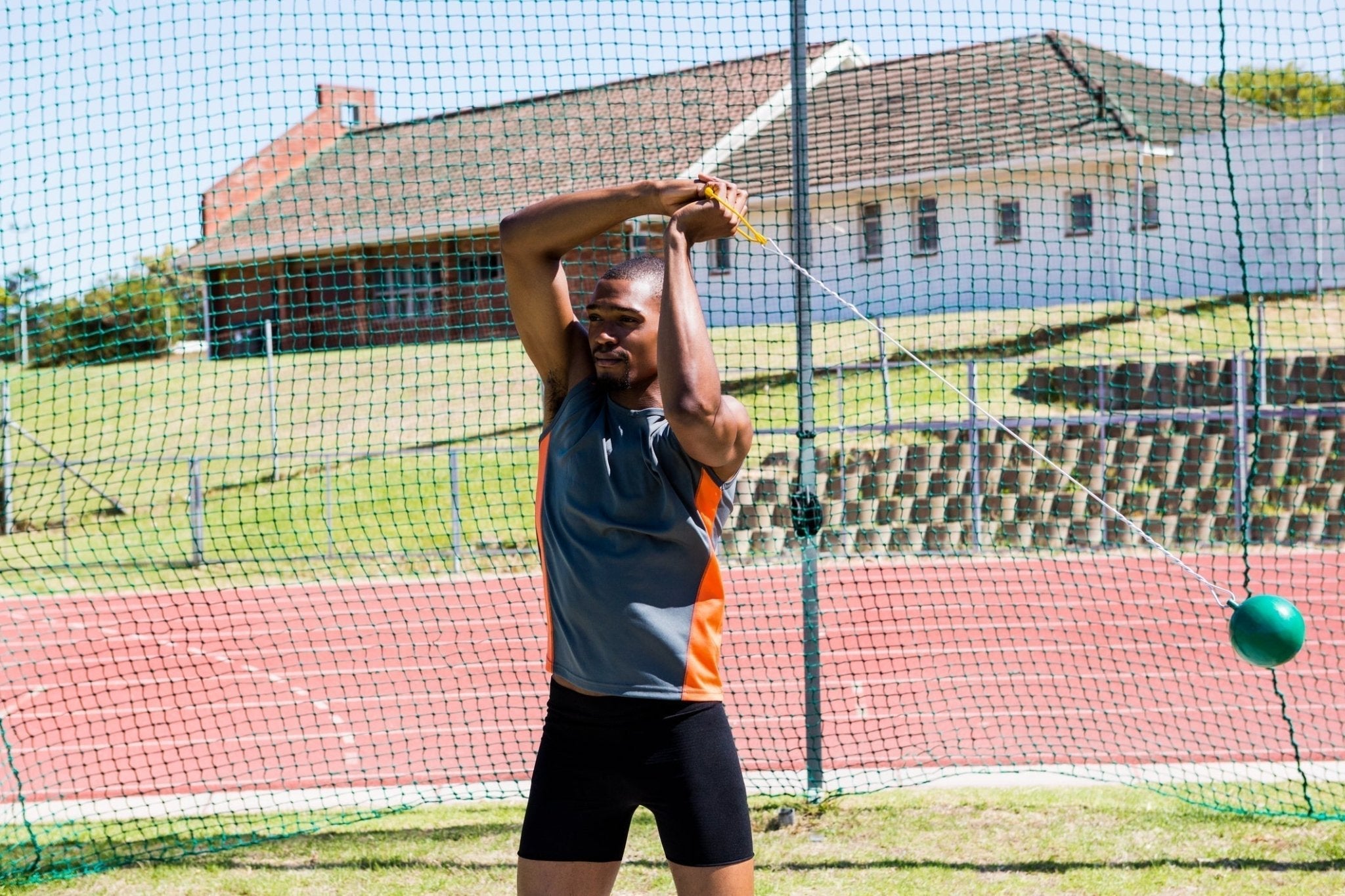

Shot put is a premier track and field event where athletes "put" a spherical metal ball weighing 7.26kg for men or 4kg for women, with legends like Ryan Crouser and Valerie Adams setting the gold standard for global dominance.
TL;DR
Shot put is a foundational track and field throwing event requiring athletes to propel a heavy metal sphere, known as the shot, using a "putting" motion from the shoulder. Competitors like world record holder Ryan Crouser (23.56m) and Nina Kennedy showcase the peak of explosive power. The sport is defined by two primary techniques-the glide and the rotational spin-and is best for athletes possessing high-level absolute strength and technical precision.

Quick Tips
1Keep the shot tucked tightly against your neck to ensure a legal "put" motion. Tip 2: Focus on explosive leg drive rather than just using your arm strength alone. Tip 3: Always exit from the back half of the circle to avoid a foul.
# In This Article
6 sectionsQuick navigation to each section of this article:
What Are the Different Throwing Events?
Throwing events represent the ultimate test of an athlete's ability to act as a human engine for an external implement. Unlike jumping events, which focus on the athlete's own body mass, throwing disciplines require the transfer of kinetic energy into objects of varying shapes and weights. The four track and field events practiced globally are the shot put, discus, javelin, and hammer throw.
While they all share the goal of maximizing distance, the "physics of the throw" varies wildly between them. The javelin is about aerodynamic lift and approach speed, whereas the hammer and discus rely heavily on centrifugal force. The shot put, however, is a game of absolute power and internal leverage. Shot putters are often the strongest athletes on the field, utilizing a "kinetic chain" that starts at the feet and ends with a violent extension of the triceps.
Sources: World Athletics Throwing Overview, Britannica Track and Field Guide

What Is Shot Put in Track and Field?
Shot put is a specialized discipline where the athlete must "put" a heavy metal ball from the shoulder using one hand. Many newcomers ask what exactly is track and field when they first see the intensity of this sport. The term "put" is legally vital; the rules state the shot must stay in close proximity to the neck or chin during the acceleration phase. If the ball drops below the shoulder line or is pulled back like a baseball, the official will signal a foul.
The event takes place within a 2.135-meter concrete circle equipped with a heavy toe board at the front. Mastery of this event requires a mix of specific training and conditioning, including heavy cleans and overhead presses to build the explosive "snap" needed at the moment of release. Athletes choose between two styles: the Glide, a linear backward hop, or the Spin, a high-velocity rotational movement similar to the discus.
"The rotational shot put is perhaps the most difficult technical movement in all of sports because you have to be a ballerina in the body of a 300-pound powerhouse." - Ryan Crouser, Olympic Gold Medalist.
Sources: USA Track and Field Rules, Olympic Games Shot Put History

What Are the Current Shot Put World Records?
The world records in shot put have seen a massive evolution in recent years, particularly in the men's division thanks to advancements in shoe technology and rotational mechanics. For decades, the records seemed untouchable, but modern training has pushed the boundaries of what is possible. Ryan Crouser's record-breaking performances have redefined the "Power Position" and the ideal release angle, which usually sits between 37 and 41 degrees for maximum distance.
Below is a breakdown of the current standing records across various categories. These marks represent the absolute peak of human strength and biomechanics. For more insights on training and performance, you can browse our news section.
Official World Records Table
Sources: World Athletics Records Vault, European Athletics Results

What Are 5 Unique Facts About Shot Put Sport?
Shot put is often misunderstood as a simple "big person" contest, but the "Science of the Shot" reveals a much more nuanced reality. From the materials used in the ball to the history of the Highland Games, the sport is rich with oddities. Here are five facts that highlight the uniqueness of this throwing event.
- Medieval Roots: The modern shot put evolved from "stone-putting" competitions among Scottish soldiers during the Middle Ages, where they used literal cannonballs.
- The "Finger-Pad" Grip: Elite throwers don't hold the shot in their palm; it sits on the base of the fingers to allow for a final "flick" of the wrist that adds significant velocity.
- Weight Scaling: The weight of the shot changes as athletes age; youth boys might throw a 4kg ball, while high schoolers use 12lbs (5.44kg), and pros use the 16lb (7.26kg) standard.
- Different Balls for Different Halls: Indoor shots are often made of synthetic rubber or plastic to protect flooring, while outdoor shots are solid iron, steel, or brass.
- The Toe Board Rule: You can touch the inside of the 10cm-high toe board to stop your momentum, but if any part of your foot touches the top of it, the throw is disqualified.
Sources: Scottish Highland Games Association, National Federation of State High School Associations
How to Choose the Right Technique
Deciding between the Glide and the Rotational technique depends on an athlete's body type and natural coordination. While the Spin offers more potential for distance, the Glide provides a more stable foundation for beginners.
- Check your balance: Rotational throwers need elite-level spatial awareness to avoid spinning out of the circle.
- Assess your height: Historically, shorter throwers used the Spin to create a longer acceleration path.
- Beginner friendliness: Start with the Glide to master the "Power Position" before attempting the complex footwork of a spin.
- Practice surface: The Glide is more forgiving on rougher concrete, while the Spin requires a smooth, fast circle.
- Stability vs. Speed: Choose the Glide if you struggle with consistent fouls, as it is much easier to control.
How to Master the Technique
Mastering the shot put is about repetition and explosive strength. The following video provides a deep dive into the specific mechanics of the throw, focusing on the transition from the back of the circle to the final release.
? Frequently Asked Questions
5 questionsFinal Thoughts
Shot put is a beautiful collision of brute force and surgical precision. Whether you are a high school athlete or a fan of the Olympic Games, understanding the mechanics of the "put" changes how you view the field. To get started with your own journey, ensuring you have the right gear is key. Ready to look the part while you dominate the circle? Check out our range of Custom Track and Field Uniforms designed for maximum range of motion and durability.
References:
Sources: World Athletics Shot Put Rules USA Track and Field Records Olympic Sport Guides